
When you lose most or all of your teeth, you need a replacement option that works for your daily life. Two popular choices are full arch dental implants and snap-in dentures.
Both use implants placed in your jawbone, but they work very differently.
Full arch dental implants typically last 20 to 30 years or even a lifetime with proper care, while snap-in dentures usually need replacement every 5 to 10 years.
The difference comes down to how each option is built and how it affects your jawbone over time
Full arch implants stay fixed in place like natural teeth, while snap-in dentures click onto implants but still need to be removed for cleaning.
Understanding which option lasts longer can help you make a smart choice for your health and budget.
The right solution depends on your bone health, lifestyle needs, and how much daily maintenance you want to handle.
Key Takeaways
- Full arch implants last decades longer than snap-in dentures because they are permanently fixed and preserve jawbone density
- Snap-in dentures cost less upfront but require more frequent replacements and adjustments over time
- Your jawbone volume and tolerance for daily removal are key factors in choosing between these two tooth replacement options
Find the Right Tooth Replacement Option in Stuart, FL
Comparing Full Arch Dental Implants and Snap-In Dentures
Both options use dental implants to replace missing teeth, but they differ significantly in how they attach and function. Full arch implants stay permanently fixed in your mouth, while snap-in dentures can be removed when needed.
How Full Arch Dental Implants Work
Full arch dental implants use four to six implant posts surgically placed into your jawbone to support a complete set of prosthetic teeth.
The most common approaches are All-on-4 and All-on-6 systems, which use strategically angled implants to maximize bone contact.
These implants act like natural tooth roots and fuse with your jawbone over time. Once healed, your dentist attaches a custom-made bridge of replacement teeth directly to the implants.
This bridge stays permanently in place and cannot be removed at home.
The implants stimulate your jawbone just like natural teeth would. This prevents bone loss and helps maintain your facial structure over time.
How Snap-In Dentures Function
Snap-in dentures are also called implant-retained dentures or removable dentures. They use two to four dental implants per arch with special attachments that click into place.
Your denture has corresponding connectors that snap onto these attachments, similar to how a button works on clothing.
You can remove your snap-in dentures whenever you want for cleaning or sleeping. Many people take them out at night, though this isn’t always necessary.
The implants provide much more stability than traditional dentures, which rely only on suction or adhesive.
However, snap-in dentures still rest on your gums, which means they don’t provide as much chewing force as fixed options.
Key Differences in Design
The main difference lies in whether you can remove your teeth. Full arch implants remain permanently fixed in your mouth, while snap-in dentures click in and out.
Number of implants needed:
- Full arch implants: 4-6 implants per arch
- Snap-in dentures: 2-4 implants per arch
Full arch systems distribute bite force directly to your jawbone through the implants. Snap-in dentures split the pressure between the implants and your gum tissue.
This means full arch implants can restore up to 90% of natural chewing ability, while snap-in options typically restore less.
Your choice between these options often comes down to whether you prefer permanence or flexibility. Full arch implants feel most like natural teeth, but snap-in dentures offer easier cleaning access.
Get Full Arch Dental Implants vs Dentures Consultation in Stuart, FL
Durability and Longevity: Which Solution Lasts Longer?
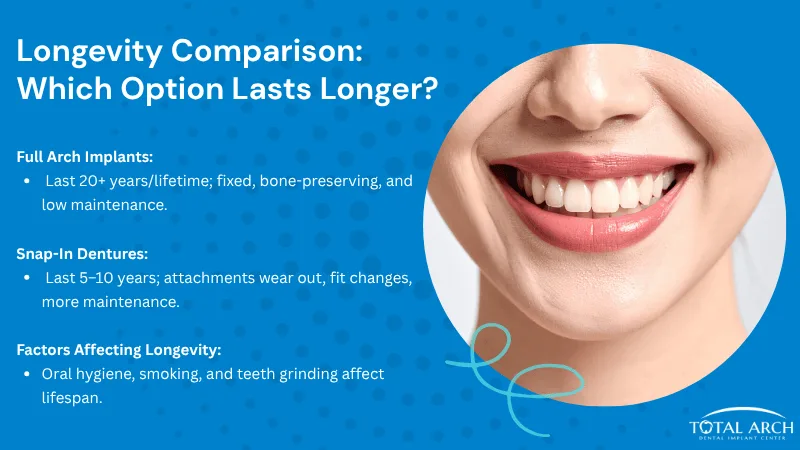
Full arch dental implants typically last 20 years or more, while snap-in dentures need replacement every 5 to 10 years.
The difference comes down to how each solution attaches to your mouth and preserves your jawbone over time.
Expected Lifespan of Full Arch Dental Implants
Full arch dental implants can last 20 years or longer, and many patients keep them for life with proper care. The titanium posts that anchor your new teeth fuse directly with your jawbone, creating a permanent foundation.
Your implant-retained dentures benefit from this stability. Once the posts integrate with your bone, they rarely need replacement unless damaged by trauma or disease.
The zirconia bridge or full-arch bridge attached to your implants may need occasional maintenance.
However, the implant posts themselves remain stable for decades. You won’t need regular adjustments like you would with removable options.
Key factors for implant longevity:
- No bone loss due to stimulation from the implant posts
- Fixed placement prevents movement and wear
- Strong materials resist daily chewing forces
- Minimal maintenance requirements after initial healing
Lifespan of Snap-In Dentures
Snap-in dentures typically last between 5 to 10 years before you need replacements. The attachments that connect to your implants wear down over time from repeated snapping in and out.
You’ll need regular adjustments even within that timeframe. The denture base can crack or break from normal use. The clips or attachments that snap onto your implants lose their grip as they age.
Your jawbone continues to shrink in areas without implant posts. This bone loss changes how your snap-in dentures fit, requiring refitting or new dentures.
Traditional full dentures face even more challenges, lasting only 5 to 7 years due to complete bone resorption.
Factors Affecting Longevity
Your daily habits play a major role in how long either solution lasts. Brushing twice daily and flossing once per day protects both dental implants and snap-in dentures from bacteria and infection.
Smoking reduces blood flow to your gums and bone. This slows healing after surgery and increases your risk of implant failure. If you grind your teeth at night, a night guard prevents damage to your prosthetic teeth.
Maintenance comparison:
| Factor | Full Arch Implants | Snap-In Dentures |
| Daily cleaning | Brush like natural teeth | Remove and soak overnight |
| Professional visits | Standard checkups | More frequent adjustments |
| Replacement needs | Rarely | Every 5-10 years |
| Jawbone preservation | Prevents bone loss | Partial bone loss continues |
The number of implants supporting your restoration matters too. More implant posts distribute chewing forces better and improve stability for both options.
Discover Which Tooth Replacement Lasts Longer
Bone Health and Jaw Preservation
Your jawbone needs constant stimulation to stay healthy and strong. Full arch dental implants provide this stimulation naturally, while snap-in dentures offer only partial protection against bone loss.
Impact on Bone Density
When you lose teeth, your jawbone starts to shrink because it no longer receives signals from tooth roots.
Dental implants work differently than dentures because they replace both the visible tooth and the root structure below your gums.
Full arch dental implants are titanium posts placed directly into your jawbone. When you bite and chew, pressure travels through these implants just like natural tooth roots.
This pressure tells your body to keep building bone tissue in your jaw.
Snap-in dentures sit on top of your gums and connect to a few implant posts.
While these implants do provide some bone stimulation where they’re placed, the areas without implants still lose density over time. Traditional dentures that rest only on your gums provide no bone stimulation at all.
Prevention of Bone Loss
Your teeth stimulate your jawbone every time you bite down. Without this stimulation, your body thinks the bone isn’t needed anymore and begins resorbing it. This process is called bone resorption.
Dental implants prevent bone loss by restoring the natural signals your jawbone needs. Full arch implants protect your entire jaw because they’re strategically placed throughout the arch.
Snap-in dentures only prevent bone loss around the implant sites. The rest of your jawbone continues to shrink slowly over the years.
Effects on Facial Structure
Bone loss in your jaw changes how your face looks. As your jawbone shrinks, your face can develop a sunken or collapsed appearance. Your lips may look thinner, and wrinkles around your mouth can deepen.
Full arch implants preserve your facial structure by maintaining bone density throughout your jaw. Your face keeps its natural shape and proportions for years to come.
With snap-in dentures, you may notice gradual facial changes over time. The areas without implants will lose bone, which can affect your appearance.
You’ll also need adjustments or replacements as your jaw shape changes from ongoing bone loss.
Functionality and Everyday Use
Full-arch implants deliver stronger biting force and stay completely fixed in your mouth, while snap-on dentures offer decent stability but can shift slightly during meals.
Chewing Efficiency and Stability
Full-arch implants like All-on-4 stay screwed into place permanently, giving you chewing power close to natural teeth. You can bite into tough foods like steak, apples, and crusty bread without worrying about movement.
Snap-on dentures attach to implants but still rest partly on your gums. They’re more stable than regular dentures, but you’ll notice some movement when eating chewy or crunchy foods. The lower jaw tends to have more shifting than the upper.
Biting force comparison:
- Full-arch implants: 80-90% of natural bite strength
- Snap-on dentures: 50-60% of natural bite strength
- Traditional dentures: 20-25% of natural bite strength
If you want to eat a wide variety of foods without thinking twice, fixed full-arch implants provide better chewing efficiency than removable options.
Comfort and Fit
Full-arch implants feel like your own teeth once you get used to them. There’s no bulky base covering your palate, and nothing presses on your gums when you chew. You won’t deal with sore spots from denture movement.
Snap-on dentures need a denture base that covers some of your gums and often your palate. This can feel bulky at first and may cause pressure points.
The snapping mechanism holds them securely, but you might need adjustments as your gums change shape over time.
You’ll take snap-on dentures out daily for cleaning and at bedtime. Some people prefer this because they can inspect everything easily.
Others find the fixed nature of All-on-4 more convenient since they brush them just like regular teeth.
Maintenance, Upkeep, and Replacement Needs
Both options require different levels of care and attention throughout their lifespan.
Full arch dental implants need cleaning similar to natural teeth, while snap-in dentures combine elements of traditional denture care with implant maintenance.
Daily Care and Cleaning

Full arch dental implants stay permanently in your mouth, so you clean them just like natural teeth. You’ll brush twice daily and floss around the prosthetic teeth and implant sites.
Water flossers work well for reaching difficult areas around the implants.
Snap-in dentures require you to remove them daily for thorough cleaning. You’ll brush the denture itself with a soft-bristle brush and non-abrasive cleaner. The implant attachments in your mouth need gentle brushing too.
You should also clean around the snap mechanisms where the removable dentures connect to the implants. Food particles can get trapped in these areas.
Most people find this two-part cleaning routine takes more time than caring for fixed implants.
Long-Term Maintenance
Full-arch implant prostheses deliver survival rates above 90% over 10 to 15 years when properly maintained. You’ll need professional cleanings every 3 to 6 months to check your implants and remove buildup you can’t reach at home.
Your dentist will examine the implant sites for any signs of inflammation or bone loss. These visits help catch problems early before they become serious.
Snap-in dentures need similar checkups for the implant posts, plus adjustments to the denture fit. The attachments that connect your removable dentures to the implants wear out over time and need replacement every 1 to 2 years.
Replacement and Repairs
Dental implants themselves rarely fail, but the prosthetic teeth attached to them may need repairs. Screws can loosen or ceramic can chip after several years of use.
Traditional dentures typically need replacement every 5 to 10 years as your jaw bone changes shape. Snap-in dentures last slightly longer because the implants help preserve bone, but you’ll still need a new denture every 7 to 12 years.
The implant posts supporting snap-in dentures can last 20 years or more. You’re mainly replacing the removable portion, not the implants themselves.
Full arch implants may need prosthetic adjustments but rarely require complete replacement if you maintain them properly.
Cost, Lifestyle Factors, and Choosing the Right Option
Both options require different financial investments and fit different lifestyles. Your daily habits, budget, and oral health condition all play a role in determining which solution works best for you.

Upfront and Long-Term Costs
Full arch dental implants cost more upfront than snap-in dentures. All-on-4 implants typically range from $15,000 to $30,000 per arch, while All-on-6 may cost slightly more.
Snap-on dentures range from $6,000 to $10,000 per arch, making them a middle-ground option between traditional dentures and permanent implants.
Traditional dentures appear cheapest initially, often costing $1,000 to $3,000 per arch. However, they need replacement every 5-10 years and require regular relining and adjustments. These ongoing costs add up over time.
Full arch implants prove more economical long-term despite higher starting costs. The implant posts themselves can last a lifetime with proper care.
You might need to replace the top portion every 10-15 years, but you won’t face the constant adjustments and replacements that dentures require.
Your location affects pricing too. Urban areas typically charge higher fees for both procedures.
Lifestyle and Convenience
Your daily routine changes differently with each option. Full arch dental implants stay permanently fixed in your mouth. You brush and floss them like natural teeth, and you never remove them.
Snap-in dentures offer more flexibility. You can remove them for cleaning, which some people prefer. They stay secure during eating and talking but come out at night.
This removable feature makes cleaning easier for some patients.
Traditional dentures require the most maintenance. You must remove them daily, soak them overnight, and use adhesives to keep them in place.
They can slip during eating or speaking, which affects your confidence in social situations.
If you lead an active lifestyle or want to eat a wider variety of foods, comparing full arch implants with dentures shows implants restore up to 90% of your natural chewing ability. Dentures only restore about 20-30%.
Who is a Good Candidate?
Your jawbone health determines candidacy for implants. You need sufficient bone density to support the implant posts. If you’ve worn dentures for years, bone loss might require a bone graft before getting implants.
Good candidates for full arch implants:
- Have adequate jawbone density
- Maintain good oral hygiene
- Don’t smoke or are willing to quit
- Have realistic expectations about recovery time
Good candidates for snap-in dentures:
- Have some bone loss but enough for 2-4 implants
- Want more stability than traditional dentures
- Prefer a removable option
- Need a more budget-friendly solution
Your overall health matters too. Conditions like uncontrolled diabetes or recent radiation therapy may affect healing. Age alone doesn’t disqualify you from either option. Many patients in their 70s and 80s successfully receive implants.
You should discuss your medical history, budget, and goals with your dentist. They can assess your bone structure through X-rays and CT scans to recommend the best option for your specific situation.
Frequently Asked Questions
Full arch dental implants typically last 20 to 30 years or more with proper care, while snap-in dentures need replacement every 5 to 10 years due to wear and changes in your jawbone structure.
What are the main differences between full arch dental implants and snap-in dentures in terms of durability?
Full arch dental implants are permanently fixed into your jawbone, making them more stable and resistant to daily wear.
The titanium posts fuse with your bone through a process called osseointegration, which creates a solid foundation that can last decades.
Snap-in dentures attach to implants but remain removable, which means the connecting attachments experience more stress from daily removal and insertion.
The denture portion itself wears down faster because it’s made from acrylic materials that gradually deteriorate with use.
Full arch implants maintain their strength because they don’t move or shift during eating and speaking. Snap-in dentures can develop wear patterns on the attachment points, requiring replacement of clips or housings over time.
How often will I need to replace my full arch dental implants compared to snap-in dentures?
You typically won’t need to replace full arch dental implants themselves once they’re placed and healed properly. The implant posts can last a lifetime, though the prosthetic teeth attached to them may need replacement after 10 to 15 years.
Snap-in dentures require replacement every 5 to 10 years as the denture base and teeth wear down. The attachment mechanisms that connect to your implants often need replacement every 1 to 2 years because they loosen with regular use.
Your jawbone naturally changes shape over time when you wear snap-in dentures, which means the denture stops fitting properly.
This requires either relining the denture or making a completely new one to match your changing bone structure.
Can you explain the maintenance requirements for full arch dental implants versus snap-in dentures for long-term use?
Full arch dental implants require maintenance similar to natural teeth. You brush twice daily, floss using special tools designed for implants, and visit your dentist every six months for professional cleanings.
Snap-in dentures need daily removal for thorough cleaning of both the denture and the implant attachments underneath.
You must soak the denture in cleaning solution overnight and brush the exposed implants and gum tissue separately.
The maintenance routine for snap-in dentures takes more time because you’re caring for multiple components. Full arch implants simplify your routine since everything stays in place and you clean them just like regular teeth.
Professional maintenance differs too. Snap-in dentures require periodic adjustments to the attachments and potential relining as your gums and bone change shape.
What lifestyle factors can affect the longevity of full arch dental implants and snap-in dentures?
Smoking significantly reduces the lifespan of both options by limiting blood flow to your gums and bone. This increases your risk of implant failure and bone loss, which affects how well snap-in dentures fit.
Your diet plays a major role in durability. Hard or sticky foods can damage the prosthetic teeth on full arch implants or crack the denture base on snap-in options.
Teeth grinding or clenching puts extra pressure on both types of restorations. You may need a night guard to protect your investment and prevent premature wear or implant damage.
Your overall health matters too. Conditions like diabetes or osteoporosis can affect bone density and healing, which impacts how long your implants stay stable in your jaw.
Are there any specific aftercare practices that can extend the lifespan of my dental restoration choice?
Using a water flosser helps clean around full arch implants more effectively than traditional floss alone. This prevents bacteria buildup that can lead to infections around the implant posts.
For snap-in dentures, storing them properly in water or cleaning solution when removed prevents the acrylic from drying out and cracking. Always handle them over a soft surface to avoid damage if dropped.
Regular dental visits catch problems early before they become serious. Your dentist can spot loose attachments, worn teeth, or early signs of bone loss during routine checkups.
Avoiding harmful habits like chewing ice or using your teeth as tools protects both restoration types. These actions create unnecessary stress that can crack prosthetic teeth or loosen implants.
What is the average lifespan of full arch dental implants, and how does it compare to that of snap-in dentures?
Full arch dental implants can last 20 to 30 years or more with the implant posts potentially lasting your entire lifetime. The prosthetic teeth attached to the implants typically need replacement after 10 to 15 years due to normal wear.
Snap-in dentures have a shorter lifespan of 5 to 10 years before the entire denture needs replacement. The implant posts that hold the dentures stay in place longer, but the attachments and denture base wear out much faster.
The difference in longevity comes down to how each option functions in your mouth. Fixed full arch implants don’t move, which reduces wear and stress on all components.
Snap-in dentures move slightly with each bite and must be removed daily, which accelerates wear on the attachment points and denture materials.
This constant motion and handling shortens their useful life compared to permanently fixed options.